AI study tools help students turn course material into explanations, summaries, flashcards, quizzes, study guides, and organized revision plans. This hub groups our practical guides by task so you can start with the learning problem you need to solve.
For a ranked, product-by-product comparison, go directly to the best AI study tools in 2026. For broader academic workflows beyond studying, see the best AI tools for students.
Last reviewed September 4, 2026. We update this hub when a tool materially changes how students can study—not simply when a new AI feature launches.
Current AI study tools by task
The strongest recent change is the move from generic chatbots toward guided and source-grounded learning. Google NotebookLM can build learning activities from materials a student supplies, ChatGPT Study Mode uses questions and step-by-step guidance, and Gemini now includes Guided Learning and Study Notebooks. These additions are reflected in our updated comparison of the best AI for studying.
| Study task | Current options | Useful when | Main caution |
|---|---|---|---|
| Learn from trusted course sources | Google NotebookLM | You want cited explanations, quizzes and flashcards grounded in your files | Check the cited passage and do not upload restricted material |
| Work through a difficult problem | ChatGPT Study Mode | You want interactive questions and guided explanations | It can still make mistakes or give an answer too directly |
| Build a personalized lesson | Gemini Guided Learning | You want a lesson, study guide or quiz around your materials | Availability and limits may vary by account |
| Create flashcards and quick quizzes | Quizlet or Knowt | You need fast active-recall material | Always edit weak or ambiguous generated cards |
| Plan long-term review | RemNote | You want notes connected to spaced repetition | Its setup is more demanding than a simple card app |
| Capture lectures | Otter | You need a searchable transcript and summary | Get permission and correct transcription errors |
| Start research | Perplexity | You need sources and search leads quickly | Open and evaluate the original sources yourself |
A product being new or popular is not enough for inclusion. We look for a clear learning use case, usable output, understandable limits and a workflow that keeps the student responsible for checking and recalling the material.

What Are AI Study Tools?
AI study tools are digital tools powered by artificial intelligence that help students learn, revise and organize academic content. Depending on the platform, they can turn notes into summaries, create practice questions, generate flashcards, suggest study plans or help break large topics into manageable sections.
Some tools are designed for fast revision, while others are better for long-term learning and exam preparation. In most cases, the main goal is the same: helping students study in a more organized and active way.
AI does not replace real learning, critical thinking or personal effort. What it can do is reduce friction. A good tool can make it easier to review materials, identify gaps and structure a study session without wasting time on repetitive tasks.
Main Types of AI Study Tools
There is no single type of AI study tool. This category includes different solutions for different study needs, and each one can be useful at a different stage of the learning process.
AI Flashcard Tools
AI flashcard tools help students turn notes, PDFs or textbook content into question-and-answer cards. They are especially useful for active recall, memorization and exam revision. This makes them a strong option for subjects that require definitions, formulas, vocabulary, historical facts or repeated review.
For product-by-product recommendations, compare our best AI flashcard generators.
AI Study Guide Generators
Study guide generators are among the most practical AI tools for students. They can organize scattered notes, simplify large topics and produce a more structured review format. This is useful when students need to prepare for a test but do not have a clear study outline yet.
A well-designed study guide can make revision more focused and reduce the feeling of being overwhelmed by too much information.
For a repeatable process, follow our step-by-step tutorial on how to create a study guide with AI.
AI Summarizers
AI summarizers help students reduce long notes, articles or reading materials into shorter and more digestible content. They are useful when the source material is dense and the first goal is understanding the main points before moving into deeper revision.
These tools can be valuable for university students, exam candidates and anyone dealing with long chapters, research material or large sets of notes. They are not a substitute for full comprehension, but they can be a strong first step in the study process.
AI Quiz and Revision Tools
Some AI study tools focus on practice. Instead of summarizing content, they generate questions, quizzes or review prompts based on notes and documents. This can be useful for self-testing, which is often more effective than passive rereading.
Students who prepare with quizzes and active recall methods usually build stronger retention over time. For that reason, AI revision tools are often most effective when combined with flashcards and study guides rather than used alone.
Benefits of AI Study Tools
The biggest advantage of AI study tools is not speed alone. Their real value is structure. Many students do not struggle because they lack information. They struggle because their materials are messy, their study sessions are inconsistent or their revision process is too passive.
AI tools can help solve these problems in practical ways.
First, they can improve organization. A student with scattered notes, screenshots and copied text can use AI to turn that material into a more coherent study resource.
Second, they can support active learning. Flashcards, questions and quizzes are usually more effective than simply rereading notes. AI makes these formats faster to build.
Third, they can reduce setup time. Instead of spending a long time preparing revision material manually, students can generate a first working version and then improve it.
Fourth, they can make studying feel less chaotic. This matters more than many people admit. When a student knows where to start, the whole process becomes more manageable.
How Students Use AI Study Tools
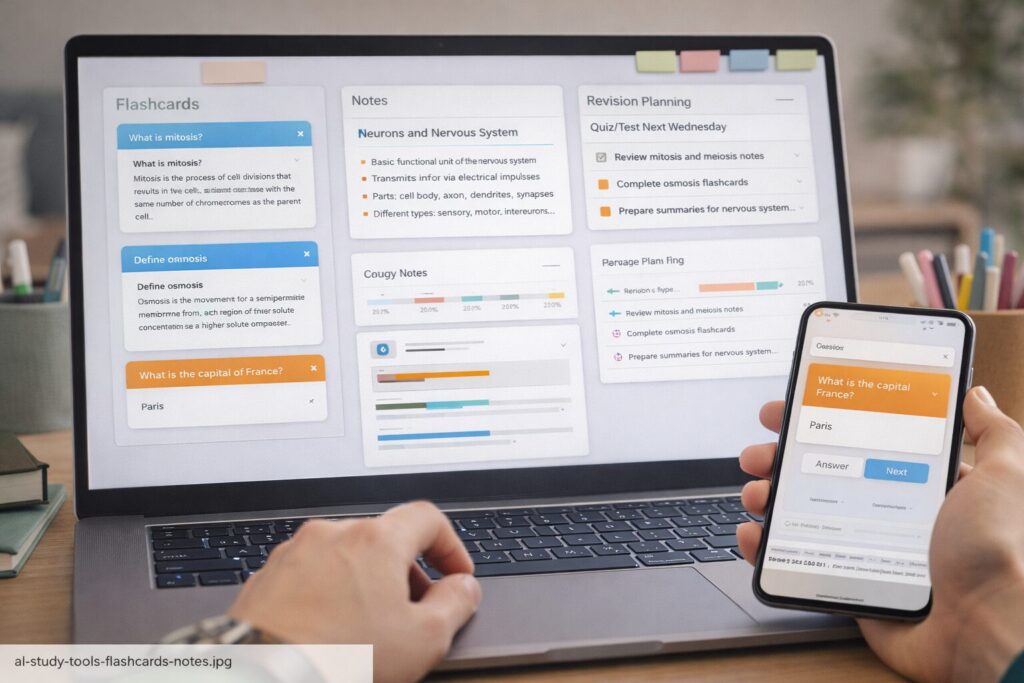
Students use AI study tools in different ways depending on their level, subject and goals. A high school student may use them to review definitions and prepare for class tests. A university student may rely on them to summarize lecture notes, extract key points from readings or build revision material before an exam session.
They can also be useful for self-learners, language learners and students who need a more guided way to organize information. In many cases, the best results come from using more than one type of tool together.
A common workflow looks like this:
- summarize notes or reading material
- turn the key points into a study guide
- create flashcards or quizzes
- review through active recall over several sessions
This approach is often more effective than reading the same material again and again without a system.
Featured Articles on AI Study Tools
If you want to explore this topic in more depth, these guides cover some of the most useful areas within AI-powered studying:
- How to Create a Study Guide with AI: The Complete Step-by-Step Tutorial
- Study Guide Generator: Best AI Tools to Create Study Guides
- AI Flashcards for Exams: The Ultimate Guide to Smarter Studying
- Best AI Flashcard Generator: Top Tools for Students in 2026
- AI Flashcard Generator Free – Best Tools for Studying
- Studyable AI Review 2026: Features, Limits and Who It Is For
How to Choose the Right AI Study Tool
The right tool depends on what the student actually needs.
If the goal is memorization, flashcard tools are usually the strongest choice. If the goal is to simplify notes and build a revision plan, study guide generators may be more useful. And, if the problem is dealing with too much reading material, summarizers can save time. If the student needs practice and self-assessment, quiz tools are often the better fit.
It is also important to look at usability. A tool may have strong features, but if the interface is slow, confusing or too limited in the free version, it may not be worth using regularly.
The best approach is practical: choose a tool that solves one real study problem well. From there, additional tools can be added only if they improve the workflow instead of making it more complicated.
AI study tools can be genuinely useful when they support active learning, organization and consistency. The best ones do not just automate tasks. They help students study with more clarity and less friction.
To explore more resources, methods and tool comparisons, check the related articles in this section and use them to build a study system that fits your needs.